

February 25, 2026
Dear Saints,
I am compelled today to share the following which was reviewed and approved by our church Session.
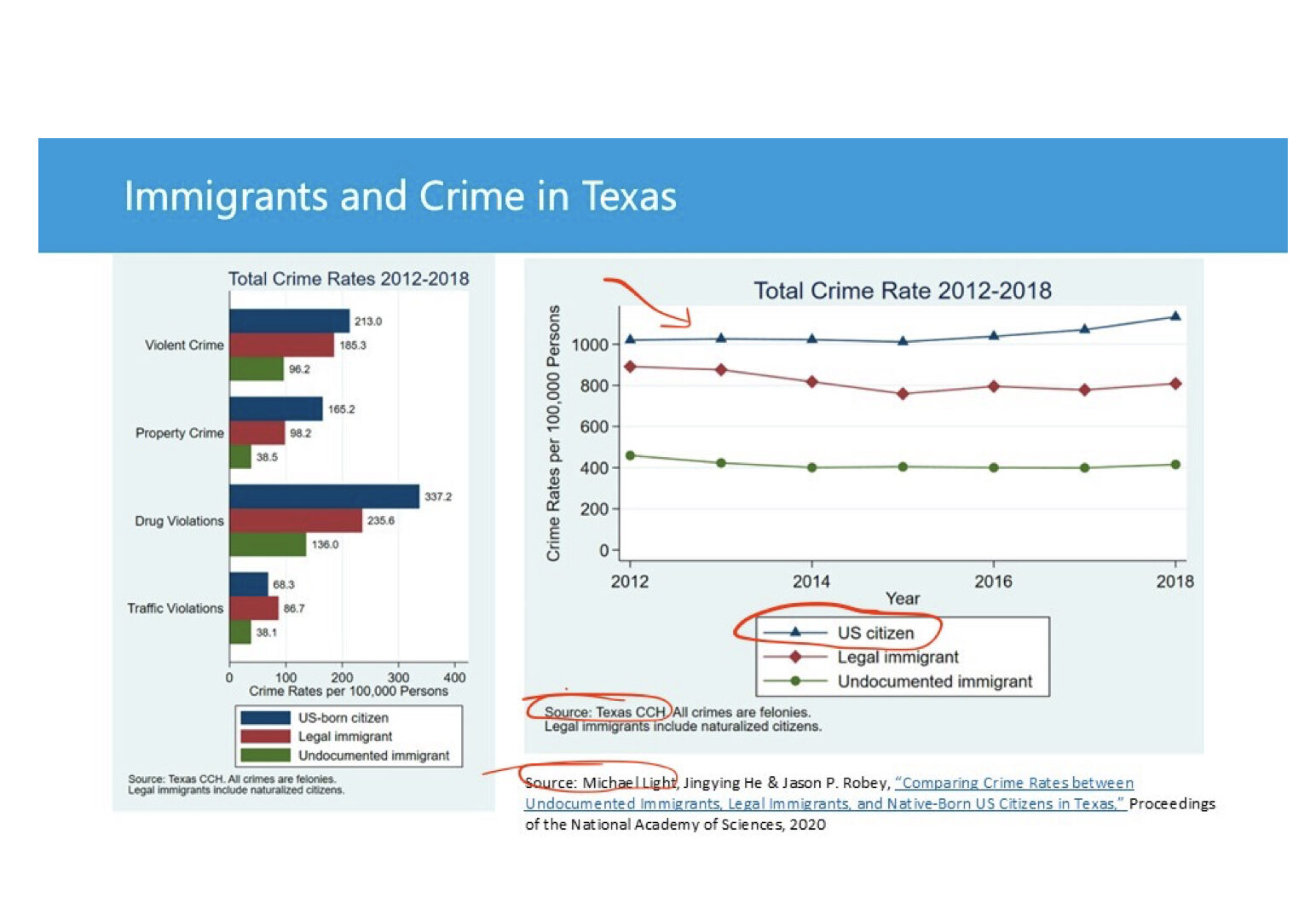
In his notes from a public presentation slide referencing the chart above, World Relief VP of Advocacy and Policy Matthew Soerens writes:
Note strong evidence – especially out of Texas, the only state out of 50 that tracks immigration legal status of those with felony convictions – that immigrants, whether lawfully present or not, actually commit crimes at significantly lower rates per capita than native-born U.S. citizens. To be clear, this data is not denying that immigrants have occasionally committed crimes, and when they do, they should face justice, but it’s not the case that they’re disproportionately likely to commit crimes or are a particular threat to public safety.
(Per an earlier post–and as we will celebrate the 250th anniversary of the U.S. Declaration this July, please also see my article, “The 7th Grievance of the U.S. Declaration of Independence Decries Tyrannical Restrictions on Vital Immigration Growth,” and its focus on immigration’s overall positive economic impact on the U.S. here (also previously reviewed and approved by our church’s Session): https://puritanchurch.com/the-7th-grievance-of-the-u-s-declaration-of-independence-against-tyrannical-restrictions-on-vital-immigration-growth.)
As I continue, I highlight that there are important disclaimers above and below in quotes by others and my own comments which I trust inquiring minds who want to know and can handle the truth will not rush over (James 1:19-20).
As Sorens said in his video I have shared [see “Immigration: Common Questions Answered [2024 Election Ready”] so he writes in his book I further cite below,
That immigrants commit relatively few crimes is not necessarily because they are more virtuous than native-born US citizens: immigrants likely commit fewer crimes because the consequences for them if they do so are often much steeper than for a US citizen committing the same crime. If, as US citizens, one of us were to steal a candy bar in the state of Indiana, we would have committed a misdemeanor offense; if convicted, we would likely get off with paying a fine. But if an immigrant with legal status were to commit precisely the same crime, they would also then face immigration-related consequences beyond the criminal penalties: they would likely be found to have committed a “crime involving moral turpitude’ that could put them at risk of deportation.” (Matthew Sorens and Jenny Yang, Welcoming the Stranger: Justice, Compassion, & Truth in the Immigration Debate: Revised and Expanded, 116)
As I circle on the diagram above, the source is a report shared by The National Academy of Sciences. It is bi-partisan officially, though known to be middle to left of center. Still, it was established in 1863 by an Act of Congress, signed by President Lincoln, as a private, nongovernmental institution to advise the nation on issues related to science and technology. Members are elected by their peers for outstanding contributions to research. Further, this factual data (not an interpretation but a presentation of them) is from the conservative State of Texas. And the facts are the facts and and not fake and the numbers don’t lie. The report can be found here: https://www.pnas.org/doi/10.1073/pnas.2014704117. From this report by Michael T. Light, here is his upfront summary:
Significance
Despite its centrality to public and political discourse, we lack even basic information on fundamental questions regarding undocumented immigrants and crime. This stems largely from data constraints. Going beyond existing research, we utilize data from the Texas Department of Public Safety, which checks and records the immigration status of all arrestees throughout the state. Contrary to public perception, we observe considerably lower felony arrest rates among undocumented immigrants compared to legal immigrants and native-born US citizens and find no evidence that undocumented criminality has increased in recent years. Our findings help us understand why the most aggressive immigrant removal programs have not delivered on their crime reduction promises and are unlikely to do so in the future.
Abstract
We make use of uniquely comprehensive arrest data from the Texas Department of Public Safety to compare the criminality of undocumented immigrants to legal immigrants and native-born US citizens between 2012 and 2018. We find that undocumented immigrants have substantially lower crime rates than native-born citizens and legal immigrants across a range of felony offenses. Relative to undocumented immigrants, US-born citizens are over 2 times more likely to be arrested for violent crimes, 2.5 times more likely to be arrested for drug crimes, and over 4 times more likely to be arrested for property crimes. In addition, the proportion of arrests involving undocumented immigrants in Texas was relatively stable or decreasing over this period. The differences between US-born citizens and undocumented immigrants are robust to using alternative estimates of the broader undocumented population, alternate classifications of those counted as ‘undocumented’ at arrest and substituting misdemeanors or convictions as measures of crime.
Something to consider: one needs only to watch the 48 Hours or 20/20 TV programs to see constant and horrible crimes committed by and upon our own native citizens. Rarely are the perpetrators in the crime documentaries immigrants. This is not to deny horrible crimes by some immigrants (some undocumented)—but such are not the norm nor the majority (though they get the most news and political coverage).
Here I hope it is helpful to share this excerpt from the book Mr. Soerens wrote:
Popular impressions … often fueled by anecdotal media narratives—are not always accurate. Many studies have looked carefully at this question, and they consistently find no correlation between immigrants and crime, in fact, immigrants (with and without legal status) consistently have lower crime rates than native-born US citizens.
One way to measure the relationship between immigration and crime is by examining incarceration: in 2014, based on US census data [Emphasis added], 1.53 percent of native-born US citizens between the ages of eighteen and fifty-four were incarcerated, but only 0.85 percent of undocumented immigrants and 0.47 percent of immigrants with legal status of the same age cohort. This disparity in incarceration rates has been consistent in studies based on census data going back to at least 1990, with the incarceration rate of native-born US citizens always at least double and sometime[s] as much as five times the rate of immigrants.
If undocumented immigrants disproportionately caused crime, we would expect crime to rise along with illegal immigration both nationally and in particular communities. Instead, the opposite is true: from 1990 to 2013, while the number of undocumented immigrants in the United States more than tripled, FBI data shows that violent crime fell by 48 percent and property crime fell by 41 percent. A separate study looking at 103 particular communities throughout the United States found “that violent crime rates tended to decrease as metropolitan areas experienced gains in their concentration of immigrants.” (Welcoming the Stranger, 115-116). [This last study referenced was from a 2009 article entitled, “Immigration and the Recent Violence Crime Drop in the United States: A Pooled, Cross-Sectional Time-Sensitive Analysis of Metropolitan Areas,” in the publication, Criminology.]
Semper Reformanda,
Pastor Grant
Categories: Articles