

May 27, 2026
Dr. Chad Van Dixhoorn’s recent article giving attention to the original Westminster Confession of Faith’s (WCF) position on consanguinity and especially affinity in marriage is most appreciated (see reformation21.org/consanguinity-affinity-and-other-points-of-divinity).
I have made significant use of Van Dixhoorn’s excellent work on the WCF throughout my church membership class booklet—including for the chapter under discussion. Still, I’d like to share an alternative view averring that the impetus for the WCF’s closing affinity clause was much less the closer historical context of King Henry VIII and instead significantly more the historic church’s common commitment. I offer the following for the reader’s further consideration.
Citing John Murray, G.I. Williamson says in his WCF commentary for study classes that the Confession is correct and historically consistent on this matter.1
The WCF 24:4 reads: “Marriage ought not to be within the degrees of consanguinity or affinity forbidden in the Word;(h) nor can such incestuous marriages ever be made lawful by any law of man or consent of parties, so as those persons may live together as man and wife.(i) The man may not marry any of his wife’s kindred nearer in blood than he may of his own; nor the woman of her husband’s kindred nearer in blood than of her own.(k)”2
Wayne Spear explains, “‘Consanguinity’ refers to blood relations, and ‘affinity’ to the corresponding relationships among in-laws.”3
The last part of this section and its specific history that is in question—on not permitting one to marry the sibling of a deceased spouse, is admittedly difficult upon first glance and a potential modern lack of familiarity. The Reformed Presbyterian Church of North America’s Testimony that goes alongside the original WCF rejects it as unscriptural (seen as contradicting the Levirate law in Deut. 25:5-10: see also Genesis 38). American versions of the WCF simply omit it (some perhaps with footnote disclaimers).
In his commentary on the WCF, Van Dixhoorn informs that “ … the Long Parliament in the 1640s struck out the last line of the fourth paragraph, an action which the Scottish Kirk ignored—indeed, the Church of Scotland ignored all of the revisions to the confession of faith imposed by the English Parliament … in the eighteenth and nineteenth centuries, this final line came to be seen as too restrictive, and so the Americans removed it from their confession.”4 (Though focusing on another topic, regarding the relevance of such differences it may be of interest to the reader to consult Brad Isbell’s recent article, “Revisionist Confessional History: The American revisions to the Westminster Confession are significant.”)
In fact, the United Kingdom overturned a standard position against such specific affinity marriages when legalizing them with its, “The Deceased Wife’s Sister’s Marriage Act 1907,” to which The Free Presbyterian Church of Scotland objected: “… The Synod gives public notice to all concerned that the Ministers of the Church shall not be at liberty to perform marriage except in strict conformity with the Confession of Faith, and that Church privileges shall not be extended to any who contract marriage under the license given by the said Deceased Wife’s Sister Act.”5
Though the original WCF’s position on affinity and marrying the sibling of a deceased spouse has more recently been seen as apparently novel, too restrictive without Biblical certainty, and thus justifiably redacted from more modern renditions, it behooves us to give more thought to why the Scottish Church did ignore such a revision in its act of ratification.6 Through many years of discussion and debate by the Divines (including the Scottish Commissioners), plenty was left out of the WCF so as to be a conciliatory document; yet this affinity clause remained initially and officially included. Among other (admittedly minority) Presbyterian churches today in America and abroad who remain full subscriptionists to the original Westminster Standards, our church Session affirms the unedited WCF affinity wording preserved by the Scottish Church.
John Murray gave special attention to this subject. In his Principles of Conduct: Aspects of Biblical Ethics, Murray lists several works that demonstrate the forbidding of wedding a deceased spouse’s sibling as the classic Protestant stance, including Calvin’s Commentary on the Four Last Books of Moses, Vol. III, pp 96-108; Kindred and Affinity Impediments to Marriage (London, 1940); and The Canon Law of the Church of England (London, 1947) , pp 126f.7
Murray exegetically explains that in Lev. 18:16, 18; 20:14, 17, 21, “The expression ‘take a wife’ indicates that more is involved than an act of sexual intercourse.”8 He points out that in 1 Corinthians 5ff, the man guilty of fornication not even named among the Gentiles is specifically guilty of affinity, and that the argument being based on Leviticus shows that these OT ethics still apply in the NT.9
Murray’s “Appendix B: Additional Note on Leviticus 18:16, 18” in his Principles of Conduct adds: “The Levirate law could well be an exception to meet a certain exigency and is quite compatible with the general provision that a man may not marry his deceased brother’s widow. The latter could be the rule, the Levirate law the exception in the extreme exigency contemplated …”10 He also notes “That a widow can be called the wife … of her deceased husband is easily demonstrated (cf. Genesis 38:8; Deuteronomy 25:5, 7; Ruth 4:5; ii Samuel 12:10; Matthew 22:25; Acts 5:7) … Hebrew has a word for widow … but it is not Old Testament usage to identify a widow as the widow of such an one. As the above instances show, it is the usage to call her the ‘wife’ … of such an one.”11 More to the point: “In reference to our precise question … the matter turns on the implications of Leviticus 1[8]:16.12 There a man is forbidden to marry his deceased brother’s widow.”13
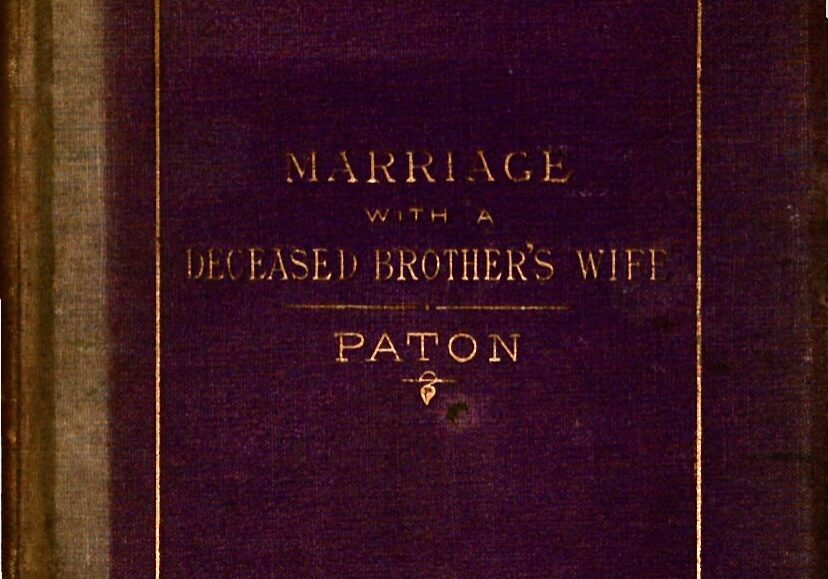
In his 1869 treatise, Marriage with a Deceased Brother’s Wife, Condemned by the Laws of Nature, Scripture, and the Testimony of Churches and Nations, the Scottish laymen Chalmers Izett Paton pulled no punches about his adamancy against the demise of national affinity laws and practices in his preface while next in his introduction crediting various Scottish theologians and ministers of his day whose works he drew upon heavily.14 Later, after carefully reviewing and quoting from early church fathers like Basil and Augustine, various early church councils, the Catholic Church, Lutherans, and Reformation confessions of the French (citing Calvin and Beza as signers), Dutch, and English (including the WCF), he concluded, “ … we have the undoubted testimony of the whole Christian Church, of every shade and degree, whether of purity or of corruption, for 1500 years, holding the marriage of a man with the sister of a deceased wife to be unlawful and incestuous.”15
The intent of this article has been to offer other reference points to what is at the least more broadly historical behind the WCF’s closing affinity clause regarding marriage. And—rather than espouse it as uniquely dangerous—we may defer to the likes of A.A. Hodge with his commentary on the WCF 24:4’s final phrase in passing, “All branches of the Protestant Church—Episcopal, Lutheran, and Presbyterian—have maintained the same principle in their Confessions of Faith or canons of discipline.”16
Footnotes:
- G.I. Williamson, The Westminster Confession of Faith: For Study Classes (Philadelphia: Presbyterian and Reformed Publishing Co., 1964), 184-185. ↩︎
- (h) Lev. 18; 1 Cor. 5:1; Amos 2:7. (i) Mark 6:18; Lev. 18:24-28. (k) Lev. 20:19-21. ↩︎
- Waye R. Spear, Faith of Our Fathers: A Commentary on the Westminster Confession of Faith (Pittsburgh: Crown & Covenant Publications, 2026), 127-128. ↩︎
- Chad Van Dixhoorn, Confessing the Faith: A reader’s guide to the Westminster Confession of Faith (Carlisle, Pa.: The Banner of Truth Trust, 2014), 329. He also suggests George Gillespie’s, A Treatise of Miscellany Questions, pp. 242-243, for more study on consanguinity and affinity. The author wishes to note here that he and his family were tremendously blessed by Chad and Emily Van Dixhoorn’s presentation on marriage and family at New Life PCA’s RefCon 2025 in San Diego. ↩︎
- See 5mt.fpchurch.ca/2024/04/History-of-the-FP-Church-Part-1.pdf. It also states, “1907-1909: DECEASED WIFE’S SISTER ACT, ETC. The Deceased Wife’s Sister’s Marriage Act, as it was popularly called, legalising marriage with a deceased wife’s sister, was passed into law by the British Parliament in 1907. As this Act was not only contrary to the law of the land, but also in opposition to the Bible teaching and the Confession of Faith, the November Synod of 1907 appointed a Committee, consisting of Revs. J.R. Mackay, Neil Cameron and James S. Sinclair, to draw up a statement protesting against the Act (‘Records of the Synod of the Free Presbyterian Church of Scotland’, 12th November, 1907).” See also media.fpchurch.org.uk/2020/06/FPM-2020-06.pdf: “The Free Presbyterian Church of Scotland has witnessed over many years against the departures from the biblical law of marriage – in particular the Deceased Wife’s Sister Marriage Act of 1907 – which have increasingly made their way into the civil law of the land.” See also pp. 260-261 of archive.fpchurch.org.uk/magazines/fpm/1907/FPM-November-1907.pdf: “No Church that is loyal to God’s Word, not to mention the Confession of Faith, can take anything else but the most serious view of this new Deceased Wife’s Sister Act. What can only be regarded as an adulterous and incestuous union has been sanctioned by the Parliament of this country to its lasting disgrace, and it will be the duty of all who are faithful to God’s truth, and love the purity of national and family life, to protest against the unhallowed enactment. We are safe in affirming that such marriages will be regarded with abhorrence in the Free Presbyterian Church, and that Church privileges will in nowise be extended to any who enter into them. They are, as we have shown, condemned by the Confession of Faith and the Word of God.” ↩︎
- It may also be worthy of contemplation about how the Church of Scotland and its ministers were of stronger, independent stock than the Church of England related to the civil government’s influence: such as the examples of Andrew Melville’s handling of King James VI and John Knox of Queen Mary. ↩︎
- John Murray, “The Marriage Ordinance and Procreation,” in Principles of Conduct: Aspects of Biblical Ethics (Grand Rapids: Wm. B. Eerdmans Publishing Co., 1957), 53, footnote 8. ↩︎
- Ibid,49-50, footnote 3. ↩︎
- Ibid, 49-54. ↩︎
- John Murray, “Appendix B: Additional Note on Leviticus 18:16, 18,” in Principles of Conduct, 250. ↩︎
- Ibid, 251. ↩︎
- Ibid, 255. The Scripture reference is actually Leviticus 16:16, but this surely is a typo. ↩︎
- Ibid. ↩︎
- Chalmers Izett Paton, Marriage with a Deceased Brother’s Wife, Condemned by the Laws of Nature, Scripture, and the Testimony of Churches and Nations (Edinburgh: H. Paton & Sons, 1869), 7-8. Free digitally online here: https://books.google.com/books?id=A7M0AAAAIAAJ&pg=PA1&source=gbs_toc_r&cad=2#v=onepage&q&f=false. ↩︎
- Murray, “The Marriage Ordinance and Procreation,” in Principles of Conduct, 55. ↩︎
- AA Hodge, The Westminster Confession: A Commentary (Carlisle, Pa.: The Banner of Truth Trust, 2002), 307. See also the author’s sermon on Leviticus 18:6-18, “Protect Your Family in the Lord”: sermonaudio.com/sermons/92115058470. ↩︎